


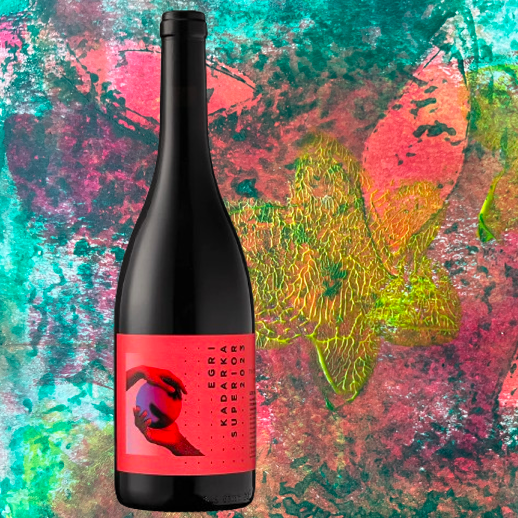
Our favourite Kadarka of the year
10 great wines to remember, #4
Silky, naughty, tricky – a lovely example of Kadarka grape variety made by Tóth Ferenc Winery in Eger. Towards the end of the year, we look back to some of the great wine moments we have enjoyed. All the 10 wines we will list until New Year’s Eve are special for some reason and they are all worth buying, multiple bottles, if you can afford. (The order is NOT a ranking.)
(Cover picture background painted by Emma Katalin Dobos)
The origin of Kadarka
“Kadarka is said to have been introduced to Hungary from the Balkans, either by Serbians, which fits with Kadarka being the Slavic name for Scutari, a lake (also known as Skadar) between Montenegro and Albania, and with the fact that the variety was once cultivated under the synonym Skadarka in Croatia and Serbia (Levadoux 1956; Galet 2000; Rohály et al. 2003), or by Turks, hence its synonym Törökszőlő (‘Turkish grape’). It is conceivable that it made its way to Hungary via Bulgaria, where it is still widely planted under the synonym Gamza, and where it is considered to be indigenous. It is also said to be “be indigenous to the region of Miniş near Arad in western Romania, where the first sweet Aszú-style red wine was made from shrivelled Cadarcă grapes in 1744 (Dejeu 2004). The exact origin of Kadarka remains unknown but it lies somewhere within the Balkan-Pannonian area.” Excerpt from: Robinson, Jancis; Harding, Julia; Vouillamoz, Jose. “Wine Grapes (9780062325518).” iBooks.
“Do you speak Kadarka?”
Kadarka is grown almost all over the country. It has significant vineyards in the Great Hungarian Plain, where Kunság, Csongrád and Hajós–Baja wine regions are situated. Kadarka is most important in Szekszárd and Eger, the two wine regions where the famous blend, Bikavér (Bull’s Blood) is made, and Kadarka is usually one component of the blend. Total plantings of Kadarka account for less than 700 hectares.
It is really hard to cultivate Kadarka. Late ripening, sensitive, its thin skin can be affected with harmful and noble rot. The colour is medium deep ruby. On the nose rich, spicy and elegant – if in good hands. On the palate juicy, spicy, medium bodied with good acidity and low tannins. Usually consumed young, within 1–3 years, but with properly restricted yield and careful vinification Kadarka can be aged for a long time – as it is proved by some vertical tastings carried on in Szekszárd and other wine regions.

Tóth Ferenc Kadarka Superior 2023, Eger
“Ruby red coloured Kadarka, quickly opening, but deep in aromas. It opens with a spicy character of clove, cinnamon, slightly vanilla with a hint of sweetness on the palate. Then shows more the fruity side, reminiscent of cherry brandy, blackberry jam. The first sip is vibrant, with moderate acidity, and finally the mature tannins gently show up. Oaky spices, little anise, tobacco, aroma comes on the nose and the palate as well.“ (Description by Adél Bernáth-Ulcz wine and chocolate expert.)
Retail price is around 15 EUR:
More information about the wine and the estate
Stay in Kadarka!
“I stayed in Kadarka and drank it, too”
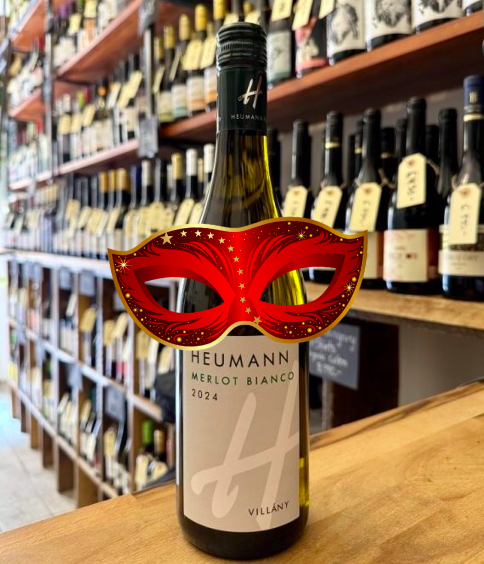
Wine of the Week: Heumann Merlot Bianco 2024, a gentleman in disguise
A white wine made of black grape from Villány. Due to TasteHangary.eu you can order it from any Eur
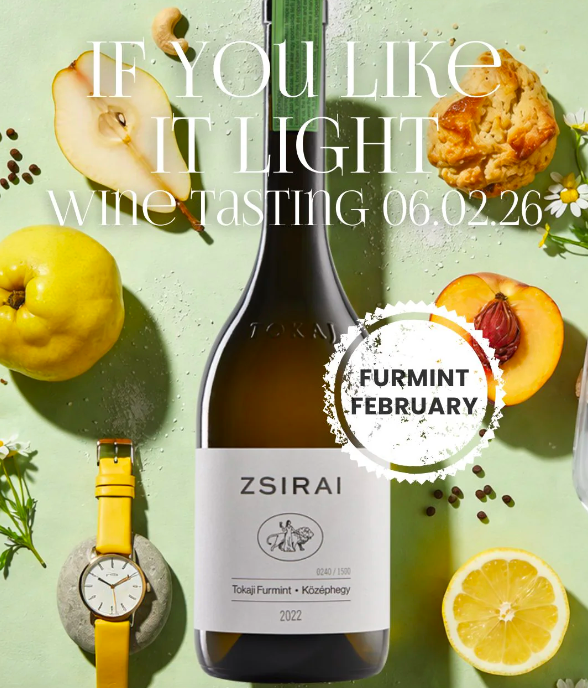
Two more Furmint tastings near Zurich in February
Vinebration wine shop will conduct two more tastings, one on the 6th and one on the 20th of February
Furmint February in Zürich on 1 February
"Discover the diversity of the white grape variety Furmint! Whether sparkling wine, white wine, or s
